
This Is The Life
On borrowed desires & scripts


This is life: we borrow our desires the same way we borrow phrases. We don’t notice we’ve picked them up until we hear ourselves saying them with conviction, usually in front of other people we’re meeting for the first time.
This is life: we pretend we’re original. Then we look around and realize we’ve been imitating all along.
René Girard, the French philosopher, coined a name for this: mimetic desire.1 We want what we see other people wanting. We’re social animals with antennae. We calibrate. We imitate. We climb. We call it ambition, taste, standards, or just trying to fit in.
I’ve started noticing the scripts I’ve been handed—by family, by work, by culture—and questioning which ones I actually chose.
This is life: the status game is always running in the background. Most of us don’t even know we’re playing it.
I grew up in one culture, and spent my working life inside another. When you navigate two entirely different scripts, you start to notice that scripts exist.
This is the life (Indian edition): your life is not just yours. It’s a group project with many editors. Friends and relatives don’t ask, What do you enjoy? as often as they ask, What are you doing nowadays? or What’s next? The questions are affectionate, even when they feel intrusive.
At social gatherings, there’s usually a subtle sorting of the world into categories that matter: respectable careers, respectable marriages, respectable choices. Even rebellion comes with its own respectable packaging. You can almost see the invisible scoreboard: stability, duty, upward motion, good schools, good choices.
This is the life: you learn very early that social approval is a kind of currency, and it wears well.
Then I entered the world of business with an American MNC, and the weather changed. The air got crisp with metrics.
This is the life (MNC edition): you take the messy business of being human and translate it into dashboards. Goals. KPIs. Development plans. Performance ratings and potential assessments that pretend to be completely objective, as if the soul could be plotted on a bell curve.
You learn to speak a new English dialect where verbs become nouns: alignment, visibility, bandwidth, stakeholder management. You learn that confidence is often mistaken for competence, and that the ability to stay calm in crises is its own form of power.
This is the life: even your better angels wear a name badge.
Roger Hodgson of Supertramp captured all this beautifully in The Logical Song: the movement from childhood wonder (when I was young, it seemed that life was so wonderful, a miracle) to institutional conditioning (they sent me away to teach me how to be sensible, logical, responsible, practical). The song’s plea—please tell me who I am—hangs in the air like a question we sometimes ask underneath the performance.
This is life: none of this is malicious. It’s just a system. But systems create desires. They decide what gets rewarded, what gets noticed, what counts as serious. And once you’ve been rewarded a few times, your brain starts treating the reward like proof.
This is life: what gets rewarded becomes what feels real.
I was ten years into the good life and career script when I realized it was a script. Position achieved. Family status: check. And then one day, sitting in the back seat of a car in Hyderabad traffic, the thought came: Wait—what other roles are available?
The question didn’t make me quit anything. It just made the frame visible.
And once you see the frame, you can’t unsee it. You keep playing the game, but now you know it’s a game, which somehow makes it both less serious and more interesting.
This is the life: at 35, I thought success was a destination with a nameplate. At 60, I think success might be noticing when you’re performing success for an audience that isn’t even watching.
By the time you’ve lived long enough, you start noticing that every culture, every organization, every era has its preferred idols. They change costumes, but they rhyme.
Who is your everyone? Chess champs rarely surround themselves with F1 racers. Do you want fashion designers at your birthday party? Will you be serving bubble tea? Writers don’t typically hang out with Liverpool hooligans or Kolkata Knight Riders superfans, and yet all of us—the writers, the fans, the racers, the designers—are convinced our square in the fabric is the one that matters.
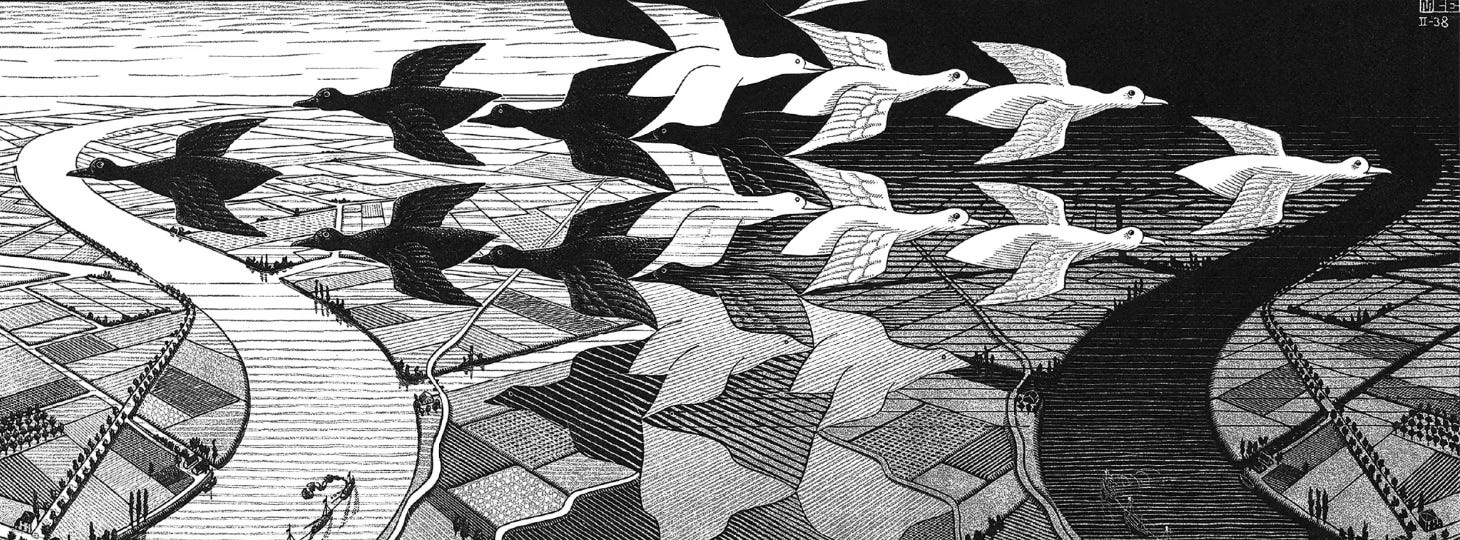
Imagine climbing high enough to see the whole weave: your professional network, your extended family, your neigbors, the tech bros chasing immortality or interplanetary travel, the Buddha under the bodhi tree, the Beatles in Rishikesh, you at age 35 climbing the ladder, you now at your desk on a Saturday morning writing essays—all as equal squares. Not hierarchically (one better than another) but horizontally. All just humans following their quests, convinced theirs matters.
Some of my cultural desires weren’t inherited directly. They arrived through crosswinds.
The Beatles, for instance, were a strange cultural bridge. A boy band travels to India, gets enchanted by a spiritual aesthetic, and sends it back out into the world in a new form. George Harrison’s fascination with Indian music and thought becomes a mainstream ripple. In Norwegian Wood: not imitation exactly, not appropriation exactly, but transmission, translation, remix. Likewise John McLaughlin’s fusion band Shakti brought this to a different era.
And then there’s satire, which functions like a fluorescent light in a dark hotel room. You didn’t realize the carpet was purple until the light turns on.
I’m reminded of Borat: Cultural Learnings of America for Make Benefit Glorious Nation of Kazakhstan. Even if you can’t recall the entire film, you may remember Cohen’s method: he doesn’t argue. He exaggerates the script until the script becomes visible. People reveal their reflexes without being asked to.
This is the life: sometimes the fastest way to see a culture is to watch someone pretend to misunderstand it.
Which brings me to the room I’ve been wandering through lately, mostly online: the tech-bro monastery, where the monks are funded and any piety vows are optional.
This is the life: the modern harpoon is a pitch deck. The modern ocean is funding. The modern whale is whatever promises to end boredom forever.
This is the life: men used to chase glory. Now they chase escape velocity, which is glory wearing a lab coat.
This is the life: immortality is marketed like a premium subscription. Mars is a side quest. Superintelligence is the final frontier. Somewhere, Captain Ahab updates his status: Grinding.
And because this is a human story, I can even understand the appeal. There’s something strangely pure about a culture that believes it can out-run death by sheer effort, out-think chaos by sheer cleverness, out-code limitation by sheer will.
This is the life: the dream is grand. The appetite is louder than the dream.
At which point, a brief word from our sponsor:

In the middle of all this, Buddhism tugs at me as a counter-current, not because it offers a shiny trophy, but because it changes our posture toward trophies altogether.
Buddhism doesn’t ask us to stop wanting. It says something subtler and more useful: notice wanting. Notice the grasping hand before it closes. Notice how quickly the mind turns desire into destiny.
This is the life: not a new object of imitation, but a new angle of attention.
But here’s the complication: I want what the Buddha attained but I don’t want to be a monk. I want the clarity without the renunciation. The detachment with the attachments. Enlightenment, but make it convenient.
Which might be missing the point. Or might be exactly the point for this former business executive trying to become a writer. After all, the Buddha was addressing a very different audience, at a very different time. He wasn’t writing a newsletter.
This is the life: enlightenment and escape velocity are both about not being here, which is interesting, because here is the only place we can ever be.
And that brings me back to the one thing I’ve learned from this roundabout tour through scripts and cultures and crosswinds.
This is my life: I’ll still want things. I’ll still imitate. I’ll still play some games. But now I see the menu clearly. And sometimes—not always, but sometimes—I remember to ask: whose script is this, and do I actually want to be in this play?
The Buddha would say I’m still missing the point.
Annie Dillard would keep saying then what?2
And they’re both right.
René Girard (1923-2015) was a French-American philosopher and anthropologist whose theory of mimetic desire argues that we don't desire things independently—we desire what others desire. Since the 2010s, his ideas have had a renaissance in Silicon Valley and tech circles, serving as a lens for understanding everything from startup competition to social media dynamics
Annie Dillard's brilliant essay This Is The Life (Harper's Magazine, 2002) asks: once you see that every culture hands you a different script for living—and they're all equally arbitrary—then what? This is my exploration. Read her original essay at the link if this piqued your interest.
Your essay ranges across a wide set of cultural references, but in my estimation the underlying tension can be distilled to three of the figures you invoke.
If we follow René Girard, desire spreads through imitation. We want what others want. Once influential actors fixate on a horizon, others mirror it. The technological singularity therefore behaves like a mimetic object. It spreads because the aspiration itself becomes contagious.
The structure resembles the visual logic of M. C. Escher. In his drawings, shapes reproduce each other endlessly across a surface. A bird becomes a fish, a fish becomes a bird. Each figure exists through repetition of another. Nothing is singular. Everything is pattern.
Seen this way, the singularity is not singular at all. It is a mimetic tessellation repeating through Silicon Valley and technology culture.
Buddhist enlightenment operates on a different logic. Awakening is not a collective destination produced by imitation. It is an individual realisation that dissolves the grasping that drives mimetic desire in the first place.
So the contrast becomes clear. The singularity multiplies the pattern. Enlightenment recognises the pattern and steps outside it.
Your essay touches many traditions, but these three references capture the conflict most clearly. Girard explains the imitation, Escher shows the pattern, and Buddhism points to the moment when the mind stops drawing the next shape.
How illuminating! Connecting Girard to Dillard via Supertramp (!) and Escher with underlying Buddhist philosophy.
Truly helped me better understand how Vipassana meditation training on improving awareness and differentiating sensations can be brought to bear on our quest for desire/status in today's world. Thank you for helping with the journey.