
The Maps We Carry
When The World Won't Stand Still

To make sense of our rapidly changing world, I read and listen to many experts. But I now realise that more experts means being shown different maps of the same island—while the island itself is turning into fish soup.
A Russian proverb says it’s easier to turn an aquarium into fish soup than to turn fish soup into an aquarium. That’s where we are right now. The post-1945 order was a well-lit aquarium: glass walls, managed currents, one big fish setting the rules. Today we’re elbow-deep in soup, and many cartographers are waving their maps saying only they can make sense of it all.
If this setup sounds familiar, it’s because I shared a fable earlier this week—seven experts, an island that wouldn’t hold still, and natives who survived by ignoring the experts’ maps.1
Today I explore what happens when we map those cartographers onto the real world.
Dan Wang doesn’t look at the old map. He walks the beach instead.2Your White Sand Beach erodes 3.2 cm after every tide, he says, but he’s also watching how the villagers cook fish, what songs the elders sing, why the young ones leave for other shores. The data matters, but also what people actually do with their lives.
He’s right. The natives watch their childhood shoreline vanish, and Dan documents both the erosion rates and the migration patterns, the infrastructure and the culture it disrupts. His precision reveals what technocrats miss—that development has social costs.
But when he synthesizes everything—technology, culture, food, opera—into one sprawling missive, the forest disappears into fascinating trees. Rich observation without predictive power.
For understanding ground-level complexity, his map is unmatched. For making strategic decisions that require choosing priorities, it’s overwhelming.
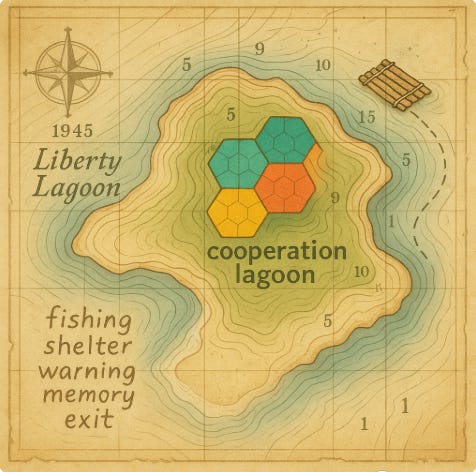
Donald clutches that 1945 atlas, the pages brittle as dried seaweed. Treasure Island’s White Sand Beach is here, he insists, stabbing the map with a cracked compass. Your measurements are wrong. My map built the modern world—see ‘Liberty Lagoon,’ and ‘Free Trade Cove’?
Kaiser Kuo challenges the nostalgia.3 The natives are pointing at their feet. Water, Donald. The water is rising. The world order Donald cherishes didn’t collapse from betrayal—it drowned under conditions it never anticipated. Those reefs? They’ve been there for decades.
Donald’s atlas did build a world where ships once anchored and people prospered. But refusing to pencil in the new reefs turns memory into delusion. When the tide washes away his favorite beach, he insists the map is right and the island has betrayed its coordinates.
For someone teaching history, that map is indispensable. For someone standing where water now reaches their knees, it’s a recipe for drowning.
George Yeo, the Tortoise watches both of them from his shell, carried across a hundred such islands.4 Donald, your map inspired trust—but trust requires revising when reefs move. Dan, your elevations are precise—but you erase the names that give meaning. He scratches five purposes in the sand: fishing, shelter, warning, memory, and exit. Same island, different maps for different fates. The tide will erase it by morning, but those who see it will remember.
He’s right that no single map serves every need. But when you’re under pressure, multiplicity can leave you paralyzed. When the storm comes, which map do you grab—the one showing the cave entrance, or where your grandfather’s house stood?
For diplomats negotiating between predators, these maps are essential. For someone who needs to run now, they’re a stack of paper in a hurricane.
But even George’s maps5 don’t account for those who must survive while giants fight.
Nitin Pai watches from the peninsula. Every map is a tool for leverage, he observes. The Eagle’s map requires submission. The Dragon’s map demands tribute. The only map worth having is one that shows how to make both of them need us—to build enough strength that neither can dominate.
He’s right that middle powers can’t just shelter. Strategic autonomy requires becoming strong enough to matter—economic growth, military capability, diplomatic weight. Build leverage, then use it.
But capability building takes decades. When the storm hits tomorrow, become a swing power isn’t a map that offers shelter—it’s a construction plan.
For states with the time and resources to build genuine autonomy, this map offers a path. For those who need safety now, it’s an aspiration without immediate protection.
Tom Friedman has a drone that buzzes overhead, a honeybee tracking multiple pollen sources.6 Everything’s going poly! The island isn’t just growing or shrinking—it’s becoming networked, interconnected, multi-layered. Polycentric power, polycrisis environment, polymorphic communities—the Polycene Era means binary thinking is obsolete.
He’s right that complexity is replacing binaries across domains. The shift from either/or to both/and is real—technology, geopolitics, environment all transforming simultaneously.
But naming complexity doesn’t tame it. His framework describes the poly-everything world eloquently. It doesn’t tell you which thread to pull when everything’s connected and you have to choose.
For understanding why simple solutions fail, this map liberates thinking. For deciding which cave shelters from which storm, it’s a map that requires calm weather to read.
Balaji Srinivasan has already lashed together bamboo, building a raft that floats beyond the island’s territorial waters.7 Treasure Island is a 20th-century creation. I’ve built a floating platform with Starlink and solar. Join me or don’t, but stop pretending ‘mapping the island’ is the solution.
He’s right that the old map is a trap. His raft is living proof that you don’t need to win the territorial game to thrive nowadays.
But exit is a luxury. When his raft springs a leak, when the storms hit international waters just as hard, when the cruise ship ignores his signal, he paddles back.
For those with capital and mobility, this map offers a beautiful opt-out. For those who must live where they are, it’s irrelevant.
Adam Tooze, the mycologist ignores everyone, digging into the soil with a microscope and a gas spectrometer.8 Your maps are useless. This island sits on a volcano. You should be building rafts, not arguing over place names.
A rumble. Ash begins to fall. The others shield their maps.
He’s right that the ground beneath is unstable. But catastrophe warnings without political engagement is surrender. When he declares the volcano will erupt regardless, he’s correct, but offers no plan for who gets the rafts, who gets shelter, who gets left behind.
For a historian writing an epitaph, this map is accurate. For someone still living on the island, it’s a death sentence without a trial.
Zheng Yongnian shares an analysis from inside the Dragon’s workshop:
You call it ideology. We call it institutional necessity. Your system assumes prosperity creates democracy. Our system assumes stability creates prosperity. Your lawyers write universal rules. Our engineers master practical governance. Our paradigms are different—but neither is ‘right’ or ‘wrong,’ just different responses to different constraints.
He’s right that China’s model emerges from pragmatic institution-building, not ideological commitment. He explains the mechanics without moral justification—how markets operate within state boundaries, why decentralization drives growth, what makes this approach work.
But mechanics without aspiration is diagnosis without direction. He explains why the Dragon has to break the aquarium, he doesn’t tell us what replaces the fish soup.
For smaller states seeking to understand their giant neighbor, this map is essential. For someone asking how do we build something beyond perpetually managing contradictions?, it’s a mirror showing the present, not a window to the future.
Between these maps lies the temptation to wait for a new world order. But as Adam Tooze reminds us, order isn’t announced; it’s ordered. The natives aren’t waiting for the perfect map. They’re salvaging solar panels from the raft, GPS from the drone, soil tests from the geologist. They’re building a shelter that offers sleep tonight, with materials from maps that dissolved in the rain.
The best lack all conviction? No—they have too many.9 Each cartographer’s framework fits their scale. Singapore’s diplomats can afford five maps because small states can turn quickly. The Eagle and the Dragon need singular maps because their movements shake the island. But most of us live somewhere between—too small to reshape the coastline, too large to ignore it.
Every framework offers clarity. Each requires us to accept its blind spots. The problem isn’t that the center won’t hold. It’s that multiple centers compete while the ground shifts beneath them all.
Maybe the point isn’t picking the right map. It’s learning from people who’ve weathered storms before—which caves they used, which songs they sang, what bent without breaking.
The Villagers didn’t solve the unmappable island problem. They’ve developed a practice of adaptation that outlasts any single map. Not one perfect shelter, but accumulated knowledge of sheltering that survives the next coastline change.

Mark Carney, Prime Minister of Canada, describes the systemic version of this flexibility as variable geometry—pragmatic, overlapping coalitions replacing outdated multilateral institutions. Nostalgia is not a strategy. The twilight of multilateralism will be followed by the rise of plurilateralism. When enough middle powers adopt such an approach, Donald’s unified order becomes structurally impossible.