
Mapping Treasure Island
A Fable For Our Unmappable Moment

A shipwreck strands seven experts on a thinly populated island with a single native village. As they attempt to map it, the island itself shrinks and expands with the tides. The water doesn’t just rise and fall—it redraws the coastline hour by hour.
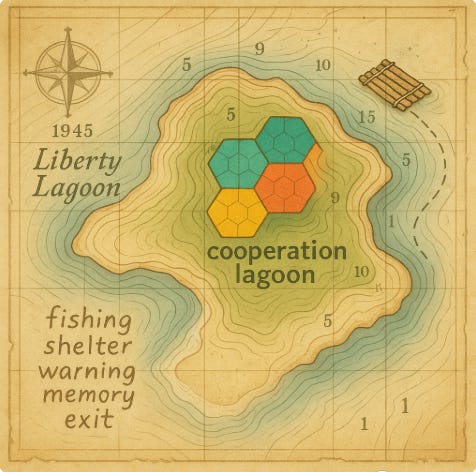
Donald the Eagle clutches his vintage 1945 atlas, the pages brittle as dried seaweed. Treasure Island’s White Sand Beach is here, he insists, stabbing the map with a cracked compass. Your measurements are wrong. My map built the modern world—see? ‘Liberty Lagoon,’ ‘Democracy Dunes.’ The natives watch him from the tree line, saying nothing.
Wang the Dragon ignores him, laser-leveling the beach that Donald claims is immutable. Your dunes erode 3.2 cm after every tide, he says, his screen showing only elevations and water flow. Nostalgia is not reality. The beach you remember is now merely a sandbar. He builds a functional map but erases every name.
George the Tortoise watches both of them from his shell, which he’s carried across many such islands. Donald, your map used to inspire trust—but trust requires revising when the reefs move. Wang, your elevations are precise—but you erase the names that give meaning to elevation. He scratches five purposes in the sand: fishing, shelter, warning, memory, and exit. Same island, different maps for different fates. The tide will erase it by morning, but those who see it will remember.
Tom the Drone buzzes overhead, a honeybee building algorithmic honeycombs from six video feeds. You’re all right! The island is simultaneously growing, shrinking, and migrating. My algorithm can map all six realities—competition reef, cooperation lagoon, climate volcano—but only if you stop fighting over ‘the one true map.’ The battery dies. He plugs into Donald’s generator, which sputters.
Balaji the Raft Builder has already lashed together bamboo. Treasure Island is a 20th-century concept. I’ve built a floating platform with Starlink and solar. Join me or don’t, but stop pretending ‘mapping the island’ is the solution. He paddles toward international waters, waving at a passing cruise ship.
Adam the Mycologist ignores everyone, digging into the soil. Your maps are irrelevant. This island sits on a volcano. These CO2 readings show eruption patterns from 79 AD. You should be building rafts, not… A rumble interrupts him; ash begins to fall; the others shield their maps.
The Villagers move their village inland, as they’ve done for generations. Children play with Wang’s discarded laser pointer. Elders use George’s sand-maps to teach tides.
When the ash clears, Donald’s atlas is pulp. Wang’s laptop is a paperweight. George’s sand-map is gone, but the five purposes remain in memory. Tom’s drone is mangled in a tree. Balaji’s raft has sprung a leak, and he’s paddling back. Adam’s body is buried in the landslide he predicted.The Villagers emerge from their shelter to assess the wreckage. They take the solar panels, the soil readings, the GPS. They leave Wang’s laptop—too rigid, requires the island to stay still. They integrate what bends into their songs.
A week later, the survivors gather on the beach. Donald waves his pulped atlas, insisting the volcano proved maps need home-made binding. Wang recalculates the blast radius to three decimal places. Tom’s replacement drone maps six contradictory lessons. The Villagers, building their third village in a century, don’t attend.
The island didn’t care who claimed to map it. It was never unmappable—only unmappable by those who needed it to stay still.
Reader syntheis via DM (shared with permission)
@The Gadfly Doctrine offered this comment:
"Here is my take on 'A Fable for our Unmappable Moment': the parable of the Pali Canon of the blind men and the elephant, the Sermon on the Mount where the meek inherit the earth, and Susan Strange offering a secular analysis.
The island parable carries most impact when read through three lenses at once: the Pāli Canon's insight that partial perception creates suffering, the Sermon on the Mount's teaching that humility outlasts force, and Susan Strange's scientific analysis of how rigid power structures collapse when conditions shift. Together they show an East–West convergence: the Buddha explains why the experts misperceive the island, Jesus explains why the Villagers endure, and Strange explains why the outsiders' systems fail. Science gives the mechanisms, the West gives the moral frame, and the East gives the wisdom of seeing things as they are.
The result is a single truth: those who grasp for control lose the island, and those who live in right relation to its movement inherit it."
His synthesis is outstanding - I hadn't consciously drawn the Pāli Canon connection, but Alan's absolutely right about the partial perception problem. What strikes me is how his three-tradition reading gives each expert dignity while explaining their failure: the Buddha shows their partial vision isn't stupidity - it's the human condition. Jesus shows the Villagers aren't clever - they're humble. Strange shows the island's shifting isn't random - it's structural change that demands flexibility.
The fact that Eastern wisdom, Western spirituality, and secular social science all converge on the same insight - those who grasp for control lose; those who adapt to reality inherit - suggests something fundamental about how humans navigate unmappable moments.