
I Am Us
Wandering Wednesdays #146

I've been thinking lately about my gut microbiome … which is an oxymoron. My gut—as if I own it; and the microbiome is an entire ecosystem with 4 trillion bacteria.
Maybe you knew this already. We’re more bacteria than human, by cell count. And the invisible passengers aren’t freeloaders—they influence what we want for lunch, how we feel about the afternoon today, and which signals travel up the vagus nerve to our brain. Scientists call it the gut-brain axis, which is a fancy way of saying that our gut bacteria are constantly messaging our neurons.
Walt Whitman memorably declared I contain multitudes way back in 1855. He had no idea.
The mitochondria in our human cells aren’t even ours. They’re descendants of bacteria from two billion years ago that decided to stay put, and have their own DNA. When you say I am thinking, who exactly is doing the thinking?
In a recent essay1, I wrote about cultural scripts that define us—borrowed desires, inherited ways of wanting. We are collections in that sense too. Which begs the question: What if the I was never singular to begin with?
Stand back from Seurat’s pointillist painting below: Sunday afternoon in the park, boats on the Seine. Then zoom in until you see thousands of dots. Red, blue, yellow. The dots are separate, unconnected.
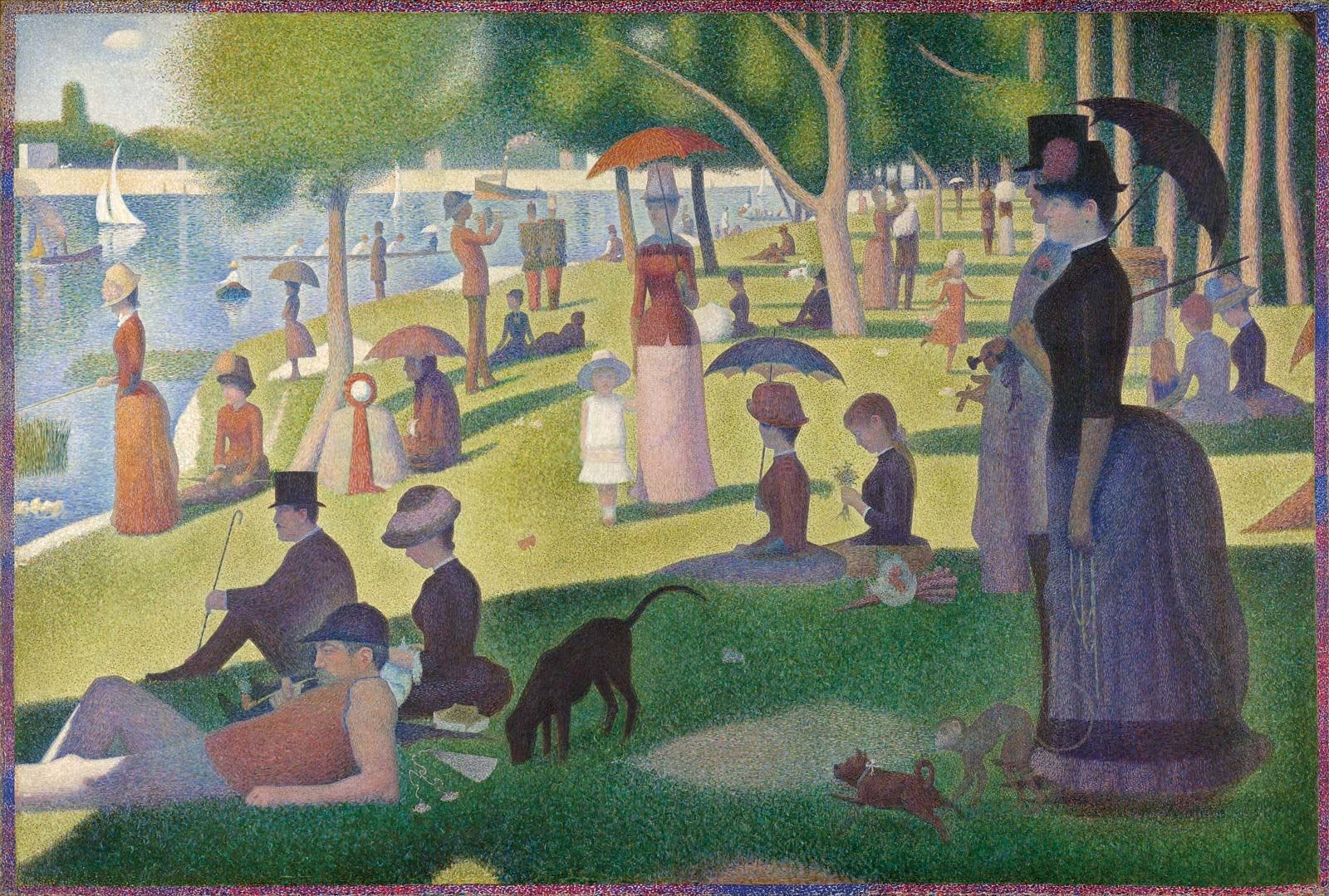
The bacteria in your microbiome are like those dots. Each bacteria species operates on its own. Zoom out: digestion, immunity, mood regulation. A coherent you.
The same thing with borrowed scripts. Family expectations here, work culture there. Individual dots. Step back: something recognizable as a self with a name badge.
Georges Seurat, the French painer, called it divisionism—dividing everything into the smallest components to create images that felt more whole than traditional painting. In many ways, we’re divisionist selves too. With parts that don’t always know they’re creating a whole.
If the I is actually we, whose decision is it when I eat something? My neurons or my bacteria? When I want that new pair of shoes after watching my friends parading them, who actually desires them? There’s no clear boundary between you and not-you. The bacteria aren’t separate—they’re integral to the whole. The scripts aren’t imposed—they’re woven into how you perceive the world. The composite is the self. The self is a composite.
We replace most cells in our bodies every seven to ten years. Different parts all the time. Still you. Somehow.
Selfhood is dynamic coordination then, not unity. A jazz ensemble improvising together—bacteria, neurons, mitochondria, inherited ideas—creating something that sounds like a melody.
Yes, the gut bacteria influence us, but we influence them too. What we eat shapes their population. Our life scripts aren’t fixed—we edit them, remix them, and reject them.
The composite can become conscious of being composite.
When I look at the Seurat painting now, I see the artist standing back, deciding where the next dot goes. We’re both the dots and the painter. The microbes and the host. The scripts and the editor.
Walt Whitman didn’t know what we know now, but he was right: I contain multitudes.
The multitudes were literal all along. We’re walking ecosystems. Mitochondrial hotels. Living pointillist paintings where the dots keep moving and the image keeps emerging and dissolving and emerging again.
Despite trillions of voices, billions of years of baggage, countless inherited desires—we still say I and point to ourselves.
The strangest part: believing the oxymoron makes it work.

MR.RAJESH just keeps imparting one surprising, fascinating insight after the next. SELECTIVE AMNESIA—I Contain Multitudes—changes the way I thought about the world & has changed who I think I’m.
I refer to I Contain Multitudes by Ed Yong, a popular science book and web series,on the subject.
https://youtu.be/UOymDhGxS9Q?si=wY3zTYgBwzW7aPNa
You have opened my eyes to read more , but in some sense our multitude are significantly diminished because most of our gut biomes have shrunk due to industrialization of food . I have recently discovered fermented millets or Ambali a way to enhance our biomes . Extending that it would be interesting to examine the diversity in our thinking, has it expanded or shrunk due. Social media and abundance of info has crowded our thoughts ….