
Stress & Stripes
Wandering Wednesdays #149

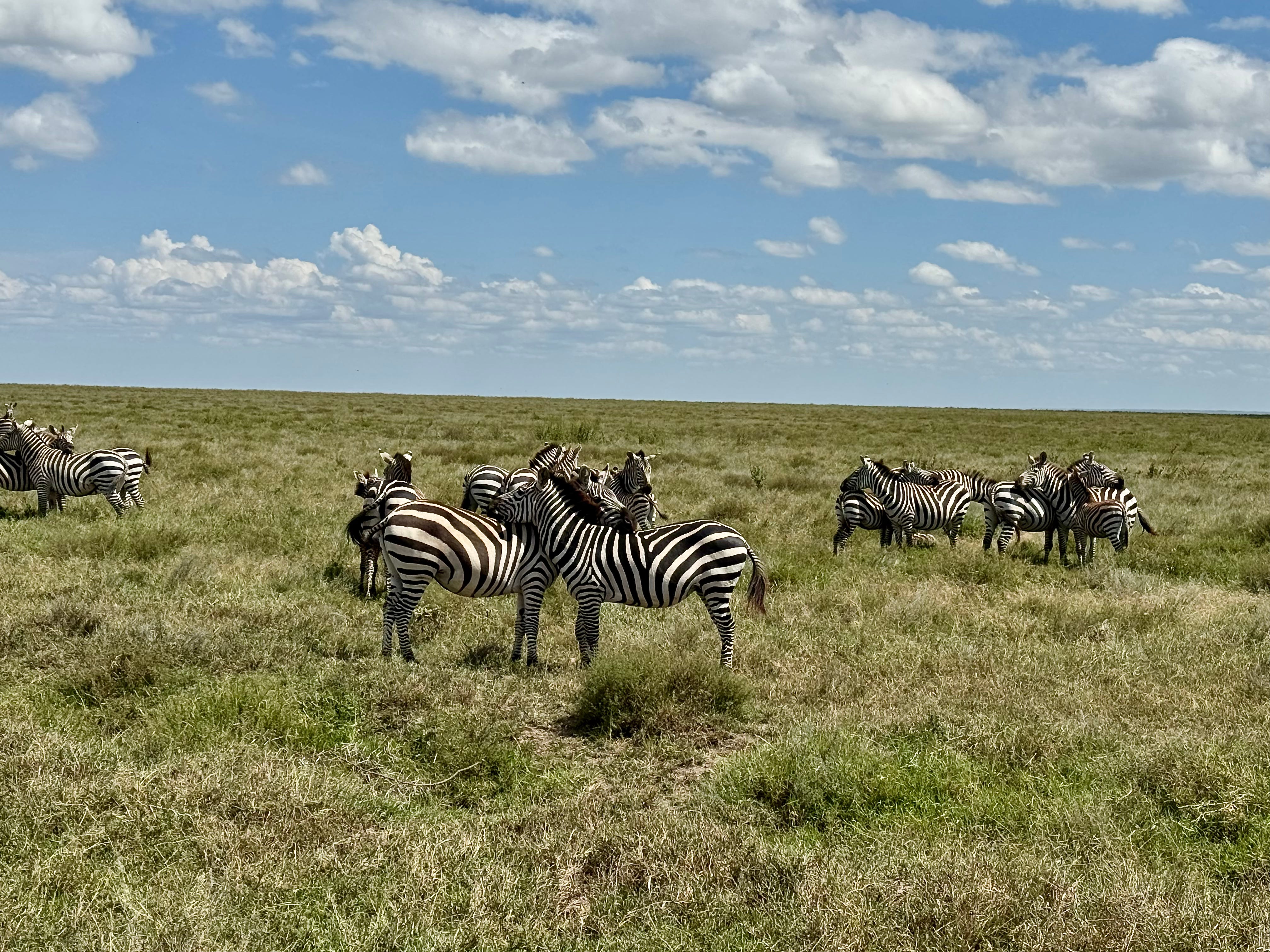
I took this photograph on a game drive in the Serengeti last summer. Notice the zebras sunning themselves, grazing. No lion in sight.
But before I get to the lion—a word about their stripes.
You’d think, on an open savannah, that the last thing an animal would want is to be conspicuous. Most prey animals invest in elaborate camouflage—dusty browns, dappled greys, the visual equivalent of keeping your head down. Zebras appear to have missed that evolutionary memo. They stand in open grassland wearing what amounts to a fluorescent (un-)safety vest.
So, why do they have stripes?
As I went digging, I found that many theories were proposed in the past century: new camouflage, predator confusion, heat regulation, social recognition. Tim Caro, a wildlife biologist at UC Davis, spent a decade testing each one of them—including taking long walks in a custom-made striped suit, counting the flies that landed on him (the things academics do for tenure!). One by one, each hypothesis failed except one.
The stripes, it turns out, have nothing to do with predators. They evolved to deter flies.
Horseflies and tsetse flies, specifically are pests that have been biting mammals since the age of the dinosaurs. Caro and his colleagues found that biting flies struggle to land on striped surfaces. The pattern seems to dazzle their low-res eyes on final approach, like an optical runway that keeps shifting. When researchers draped striped blankets over horses, fly bites dropped dramatically. The zebra’s entire visual identity with that magnificent, impractical-looking coat evolved to deal with a daily pest, not the apex predator.
Which brings me back to the photograph … and the missing lion.
A zebra chased by a lion sprints for about thirty seconds. If it gets away, it goes back to grazing. No post-mortem, no group debrief on what the lion could have done or might do next. No sleepless nights replaying the chase from different angles.
But we humans can run from the same lion for decades. And the lion doesn’t even have to be real.
A deadline three months away. A difficult conversation that hasn’t happened yet. A diagnosis you Googled at 2am. Our body doesn’t distinguish between any of these.
It floods the same cortisol, tightens the same arteries, and raises your blood pressure—whether the threat is a set of jaws or a set of what-ifs.
Robert Sapolsky, the Stanford primatologist who published Why Zebras Don’t Get Ulcers, put it simply: if your blood pressure spikes because a lion is actually chasing you, that’s your body saving your life. If it spikes every time you’re stuck in traffic or picked the slow line at the grocery store, that’s stress-induced hypertension. Do it often, he notes, and the cardiovascular damage exceeds what smoking, obesity, or elevated cholesterol would cause.
The imagined lion is the most expensive pet we keep.
And the habit is stubborn, because worry disguises itself as diligence—as love, even. Someone has to stay up and watch for lions, the mind insists, even when the savannah is empty and the only predator in the room is the rehearsal of a conversation that may never happen.
The zebra seems to know two things we’ve forgotten. Its stripes say: the real threat is the pest, that persistent small thing. And its grazing says: it’s safe now. Enjoy the bounty while it lasts.
Mindfulness teachers have been saying this for centuries. Be present. Let go. Return to the breath. They’ve designed expensive retreats and apps around the insight.
While the zebras touched grass before it became a thing.
With a name that has a rat in it I am running the rat treadmill trying to find the lion. More stressful by far 😂😂😂
Rajesh the moral of the story is right on. I too find myself sometimes over thinking or making too much of something said or unsaid. This essay is a great reminder. As a sidenote, we went on Safari in Kenya last year, and I didn’t know about the flies on the zebra. We were told that it was when grouped in formation the zebras don’t take on the form of a prey, rather a confusing mass of stripes. Whether they do or don’t, they should not worry about it!