
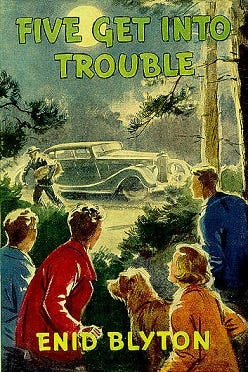
Five Get Into Trouble
That Was Then, This Is Now

In 1970s India, in the sleepy steel town I grew up in, summer holidays meant shirts permanently stuck to our backs and devouring Enid Blyton’s Famous Five. None of my friends or I had any idea what ginger beer was, or moors, or lashings of anything. One friend imagined sardines as a kind of kebab. Another pictured lacrosse as a slo-mo exercise involving butterfly nets the ultimate aim of which remained hazy.
None of this mattered though. In those pre-Internet days, what you couldn’t look up, you made up—and the making-up was part of the magic. We built bridges from our living rooms to the English coast without getting up from our beds. We packed cucumber sandwiches and homemade lemonade and took off on our bicycles, re-enacting adventures that bore no resemblance to our lives but felt entirely our own.
The appeal, looking back, was elemental: five children, no adults, a mystery to solve.
Half a century on, five men have embarked on an unsupervised adventure of their own. The mystery is bigger. The dog is missing. They don’t like each other. And nobody has called them home for tea.
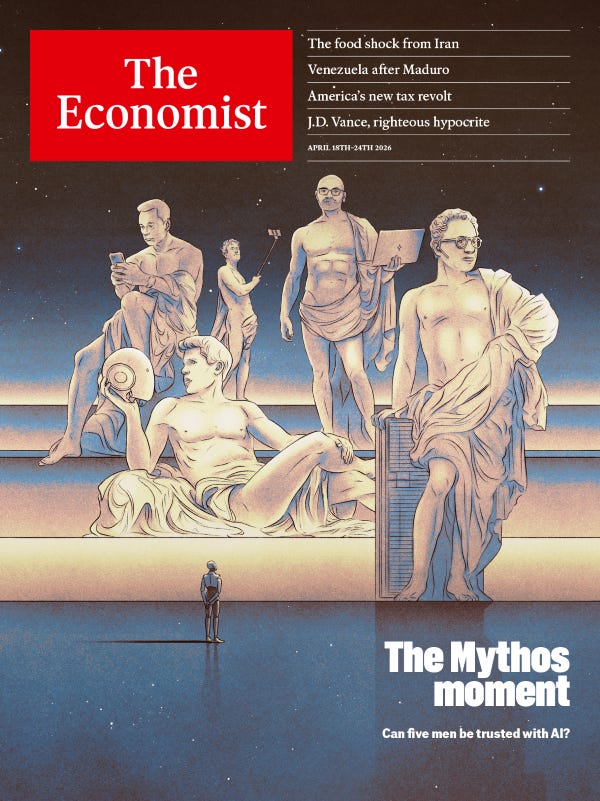
Not just me, the world has noticed. The Economist cover casts them as Greco-Roman gods—marble torsos, draped in togas, absorbed in their devices, ignoring the tiny solitary human standing below in the darkness. Can five men be trusted with AI? asks the subtitle. The gods aren’t watching us. They’re manically scrolling.
The consolation, if Paul Krugman is right, is that whom the Gods would destroy, they first put on magazine covers.
In the same issue, the Economist dresses these five in frock coats and top hats, laptops balanced on their knees—Victorian businessmen with WiFi. The parallel is not new, but it is apt. 150 years ago, America’s post-Civil War industrial boom produced its own handful of men whose power, ambition and strangeness probably graced every magazine cover of that era.
Andrew Carnegie, Scottish immigrant and steel baron, grew up in a one-room cottage, was so frugal he wore the same coat for years even as he amassed one of history’s great fortunes—then gave away 90% of it to build 2,500 libraries. Penance dressed as philanthropy, or philanthropy born of penance. John D. Rockefeller, who tithed from his first paycheck, built Standard Oil into a lean extraction machine, obsessed over saving pennies even as he became the world’s richest man, and fought antitrust for decades. J.P. Morgan, the banker who bailed out the US Treasury in 1895—yes, a private citizen backstopped a sovereign—and who consulted astrologers before major deals. Thomas Edison, electricity pioneer, fanatically opposed to sleep, who electrocuted animals in public to discredit a rival’s superior technology. Henry Ford, who democratised the automobile, doubled wages, and published antisemitic propaganda that the Nazis cited as inspiration.
Not one of these men was universally liked. Every one of them was consequential. And each one operated in a world where European competitors—Krupp in steel, Rothschild in finance, Nobel in chemistry—ensured that no single nation had a monopoly on the frontier.
The railways they built and financed were that era’s defining technology: transformative, speculative, irresistible. Too many railroads spanning too many miles carrying too little traffic—it was madness, but FOMO kept the capital flowing. The busts came when interest payments were missed and solid ground turned to quicksand. The pattern looks familiar to anyone watching the GPU buildout underway today.
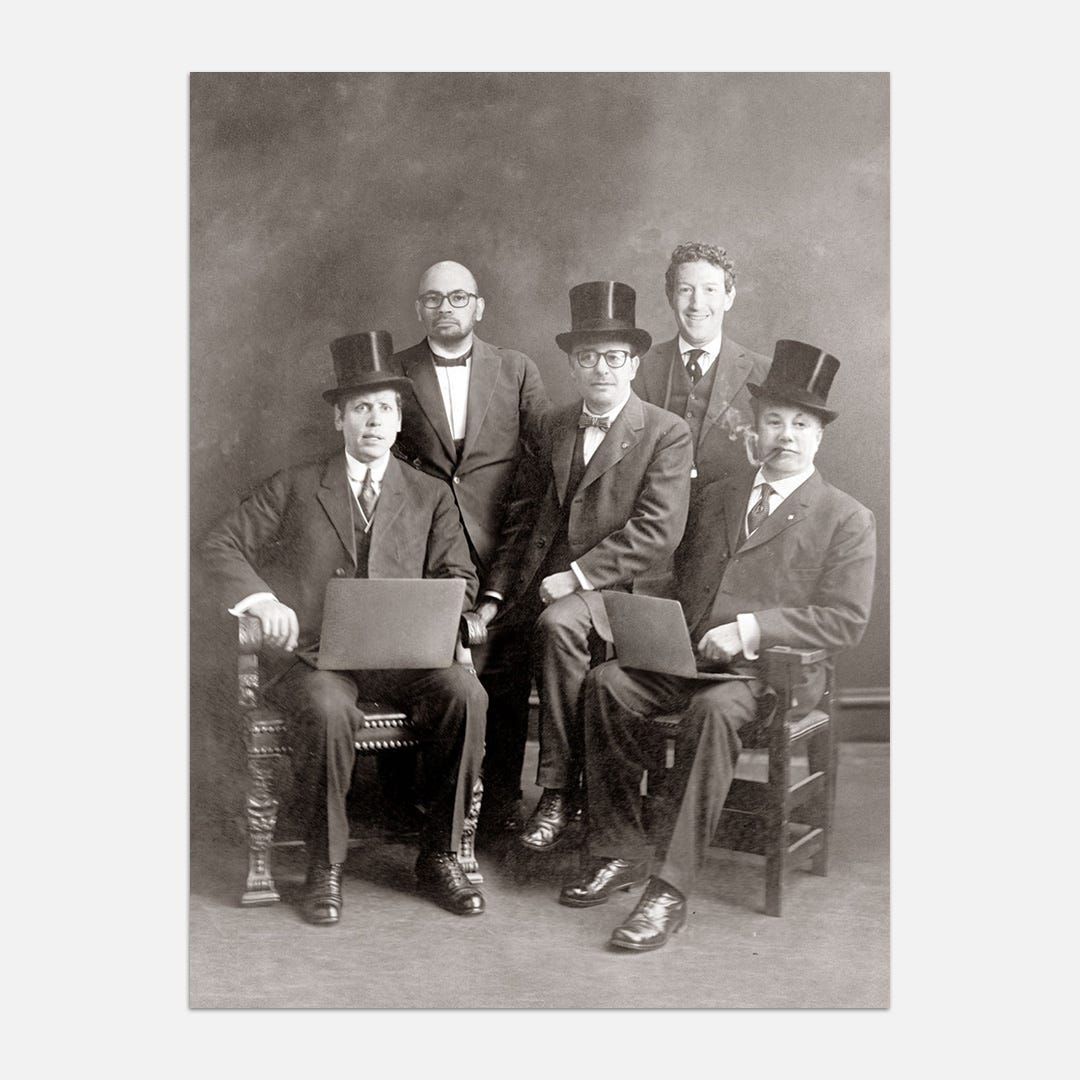
Now, here’s what the frock coats conceal about the new five.
Demis Hassabis, Nobel winner, chess prodigy turned neuroscientist turned Google DeepMind CEO, speaks about the technology with the reverence of someone pursuing a spiritual calling. Dario Amodei, former OpenAI researcher who left to build Anthropic around the conviction that the most powerful technology in history should not be deployed by people who haven’t thought hard about what happens when it goes wrong—and who, when his company produced a model capable of hacking virtually every major OS on earth, chose not to release it. Sam Altman, who ran Y Combinator and then OpenAI, who speaks fluently about existential risk and races to ship product in the same breath, and whose board fired him and then hired him back within a week—a sequence that tells you most of what you need to know. Elon Musk, who built PayPal, Tesla and SpaceX, sued OpenAI, started xAI, and posts conspiracy theories to his 200 million followers at 2am—a man whose genuine engineering brilliance has become increasingly difficult to separate from his need to set every room he enters on fire. Mark Zuckerberg, who connected three billion people and then watched his platform degrade elections across multiple democracies and fuel a teen mental health crisis—and who pivoted to courting the incoming administration with the same frictionless opportunism he brings to everything else.
Not one of these men is universally liked either. And the FOMO that drives their rivalry—the race dynamic, the fear of falling behind—encourages corners to be cut by people whose values, in several cases, cannot be trusted to hold the line.
Now, notice what’s missing. Carnegie had Krupp. Rockefeller had the Rothschilds. Edison had Siemens. These five have no global counterweights, no peer competitors operating from a different tradition with a different set of instincts. The entire frontier is concentrated in America’s tech ecosystem. The only significant alternative is China—state-directed, opaque, and running on a fundamentally different operating system with different priorities.
These five men represent two different kinds of danger that history has seen separately but never together. The first is the Gilded Age problem—private power so concentrated it captures economic gains and corrupts political systems. The second is the nuclear weapon problem—a technology whose destructive capability demands institutional architecture that no single nation can build alone.
The Gilded Age was solved domestically, through politics. The nuclear age required international cooperation. The AI age demands both simultaneously, and at a speed that may not allow either.
The parallels are instructive. But they only go so far.
Mark Twain coined the phrase, The Gilded Age, in 1873 to describe an America that was glittering on the surface and rotten underneath. For three decades, new technologies transformed the country while a handful of men captured most of the gains. It took thirty years of panics, strikes, violence and muckraking journalism before politics finally caught up: antitrust law, the Federal Reserve, the Progressive Era. The markets didn’t produce the change. Politics … eventually did.
The nuclear age moved faster, to build international guardrails. In 1945, a team of physicists delivered the atomic bomb to the US government, which used it within weeks. The scientists were the famous five of their era—Oppenheimer, Fermi, Teller, Szilard, Bohr—brilliant, conflicted, and unable to control what they’d built. But political leaders, terrified by what they saw, began building institutional architecture that crossed national boundaries. The Cuban Missile Crisis in 1962 accelerated everything: within six years, the Nuclear Non-Proliferation Treaty (NPT) was signed. The terror created the treaty. Not goodwill—the abyss, glimpsed and recoiled from.
Now consider where we are. The AI equivalent of the bomb has been developed but not yet dropped. The five lab leaders are the nuclear scientists—they understand the physics, they see the danger, and at least two of them have shown genuine restraint. But the political leadership that negotiated the NPT is absent. The AI summit that began at Bletchley Park in 2023 as an AI Safety Summit was rebranded in Paris as an AI Action Summit and in New Delhi as an AI Impact Summit—the word safety disappearing from the marquee. The serious safety conversation has migrated to online forums, technical papers, and a handful of books that many policymakers will never read.
Meanwhile, the US and China are each modelling the other through the lens of their own assumptions: America assumes China will be constrained by hardware deficits; China assumes America will be consumed by internal dysfunction. Both are probably wrong in ways neither can yet see—and neither has built any verification infrastructure or diplomatic channels that might allow them to discover this before it is too late.
The Gilded Age had thirty years to find the right policies and build the right checks and balances. The nuclear age, which demanded cooperation across borders, had six. The AI age may have three at most—because AI models grow more powerful with each generation, and both their productive and destructive capabilities compound faster than any previous technology.
The NPT didn't end the arms race—stockpiles tripled in the decade that followed. But it created a floor beneath the competition, a set of rules that outlasted the specific rivalry it was designed for. Whether anything comparable is possible for AI, and whether three years is enough time to build it, may be the most consequential question of our era.
So what could happen next? Historians studying America’s first Gilded Age offer a sober answer. The robber barons were eventually tamed by muckrakers, reformers and an accidental president nobody expected to act. Today, the muckraking function is being performed by some lab leaders themselves—Dario holding back Mythos, Demis flagging risk—which is admirable and terrifying in equal measure, because it means the restraint is voluntary, personality-dependent, and one accident away from disappearing. The reformers and accidental presidents who ended the first Gilded Age are nowhere to be seen.
I am reminded of this painting I saw recently, by George Voronovsky, The Harvest and the Train. A steam engine runs through the centre. Below it, people gather wheat. Above it, a town with onion domes carries on. The birds ignore the train entirely. The technology is present but doesn’t dominate, it’s one layer among many. The perspective is flat, democratic—no marble plinths, no gods gazing down. Just a landscape undergoing transformation, with the harvest continuing regardless.
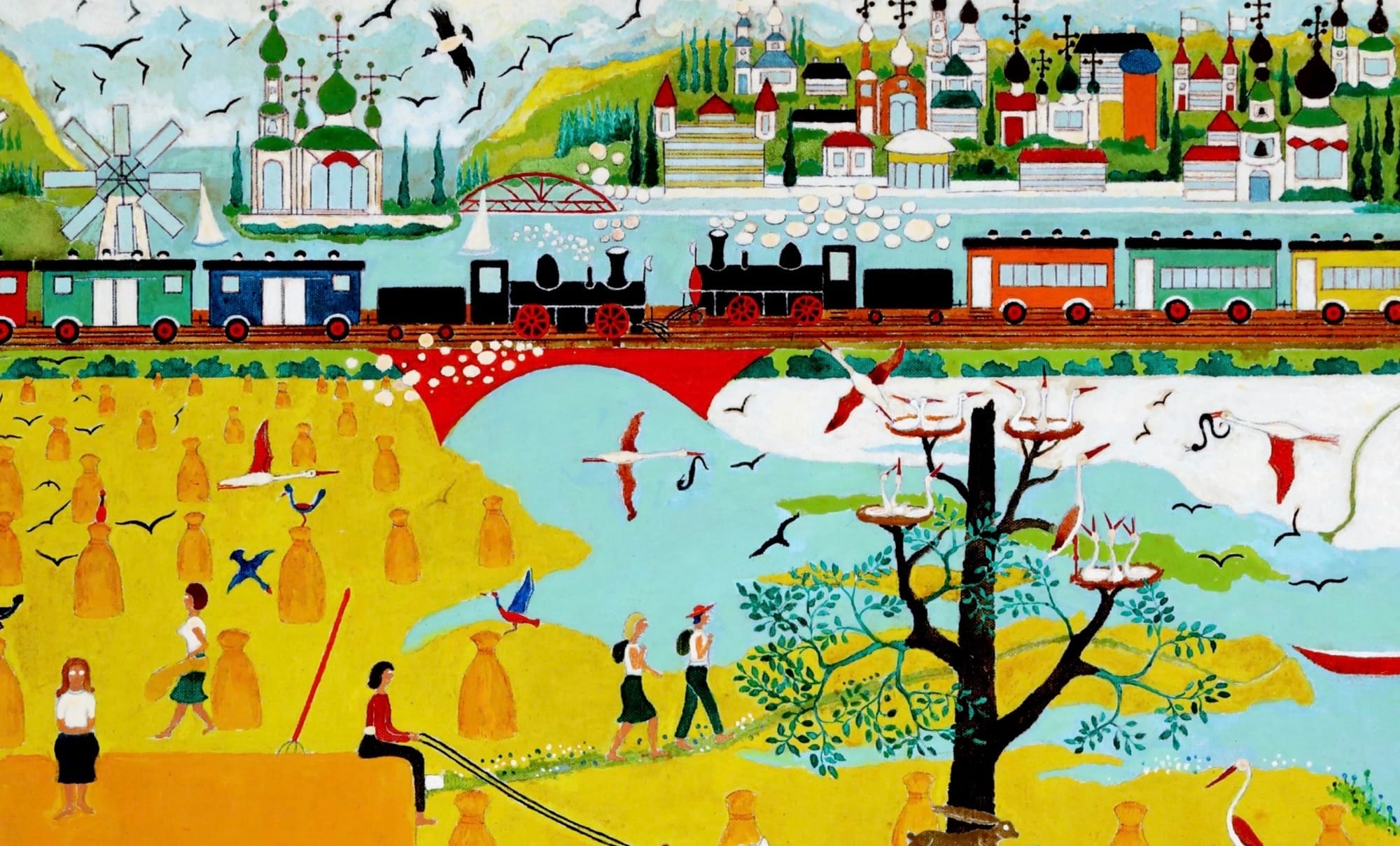
It’s an inverse of the world we find ourselves in now.
In my 1970s childhood, what you couldn’t look up you made up—and the making-up was the magic. That innocence isn’t available to us now. The mystery is real, the stakes are real, and the five are no longer children. Enid Blyton always brought her characters home. Someone left a dog and a bicycle and a packed lunch at the starting line. Someone expected them back before dark.
Who will call these five home—and will they come when called?