
Common Creativity
Future Tense #4

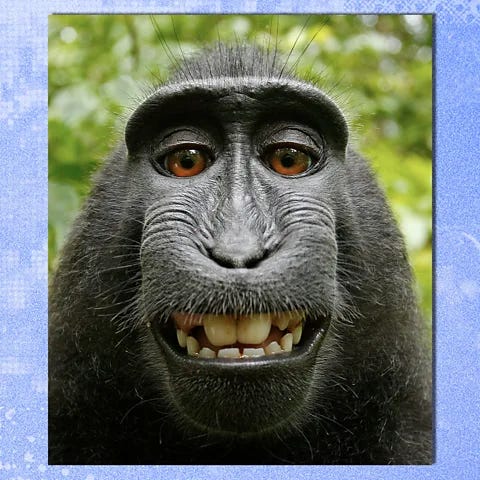
In 2011, a photographer, David Slater, left his camera on a tripod in an Indonesian jungle. A crested black macaque picked it up, found the shutter button, and took a selfie. The photo went viral and then the lawsuits began.
The photographer said the image was his. An animal rights organisation sued on behalf of the monkey. A judge threw it out—monkeys can’t file lawsuits. The photographer went nearly bankrupt. The image ended up in the public domain. Nobody owns it. And that’s why I can use it here.
A decade later, a computer scientist had his AI system generate an image and tried to register the copyright. The copyright office refused. Same logic as the monkey image. No human author, no copyright. He went all the way to the US Supreme Court. Lost. The ruling stands: if AI creates something, nobody owns it.
A macaque in Sulawesi set the legal precedent for every AI-generated image, text, and piece of music produced ever since.
If you’re a creator, you maybe upset with machine imitations. If human creativity can’t be protected, what happens to creators? But that question assumes creativity is a fixed thing—a territory to be defended rather than a practice that evolves.
Consider what actually happened when ChatGPT image generation went mainstream. For a few weeks, the internet was flooded with Ghibli-style portraits. Critics went up in arms. The cheapening of craft, the death of artistry, the end of everything. Then people moved on. Some discovered Ghibli for the first time. Others learned to push the tools further. The Ghibli slop phase passed quickly, the way it always does.
This pattern is not new. Photography was supposed to kill painting. Digital cameras were supposed to kill photography. Photoshop was supposed to cheapen both. Phone cameras made everyone a photographer—which is to say, they made photography ordinary and forced career photographers to become extraordinary in different ways. Each wave of democratisation produced a flood of mediocrity—slop, if you prefer—and a smaller, stranger, more interesting cohort of creators who used the new tools to do things nobody expected.
In 2021, a digital artist named Beeple sold a collage of 5,000 daily images for $69 million—the most expensive NFT ever auctioned. He could have stopped there. Instead, he started incorporating AI into his practice. His latest work at LACMA invites visitors to collaborate with an AI system to transform public domain artworks in real time. The audience becomes part of the creation. The artist didn’t defend his territory. He redrew the map.
But democratisation isn’t uniform, and the transition isn’t painless.
Music is where the story turns harder. Streaming platforms now host millions of AI-generated tracks competing for the same finite royalty pool as human artistes. The labelling is coming, slowly—but the economics are already shifting underneath. A musician spends three days or three years creating an album. A listener asks a streaming service like Spotify to play something for a rainy afternoon. Spotify assembles a playlist. The musician’s song isn’t on it—but something that sounds like it is. Nobody samples the musician. Nobody visits their channel.
The legal protection exists—human-created work can be copyrighted, AI-generated work cannot. But if nobody listens to the musician because the platform surfaced something artificial, what does ownership mean?
The same tension is playing out in advertising and corporate videos—anywhere the gap between good enough and worth paying a human for is narrowing. In some places, I expect AI tools to handle the routine work and free creators for more ambitious things. In others, it will slowly replace them and nobody will notice until the quality thins out. This won’t be uniform. It has never been.
The monkey selfie made us argue about the wrong question for a decade. We debated who owns the photo. The deeper question was what happens to creativity itself when the tools that make it possible become available to everyone.
The camera didn’t kill the painter. The printer didn’t kill the writer. The synthesiser didn’t kill the pianist. The monkey didn’t kill the photographer. What each one killed was a particular monopoly of a particular tool.
But this time is different. AI doesn’t just assist, it generates.
Back then, a photographer still framed the shot. A drummer still kept the beat. What happens when a machine does both—and the audience can’t tell the difference? Will visual art follow painting’s path after the camera—retreating from representation into something stranger and more personal? Will music split into two domains—one human, one synthetic—the way theatre survived cinema? Or will something happen that nobody has predicted yet, the way it often does?
Someone, somewhere right now, who never thought of themselves as a creator, is making something for the first time. That's how every creative revolution has started.
P.S. This is the fourth issue of Future Tense, a monthly series on what’s arriving and what questions we should be asking before the answers become obvious. The future is already here, just unevenly distributed. Previous edition here.
MR.RAJESH ACHANTA in fourth issue of Future Tense, shares what’s arriving and what questions we should be asking before the answers become obvious. The future is already here, just unevenly distributed.
Well,MR.RAJESH knows as much as any human being can know about AI and writes thought provoking,research based essays on AI.
“Common Creativity” essay itself evidences what has come and itself answers the question we should be asking about future. How !
Why MR.RAJESH writes an essay when he can type a few words and have AI generate one for him? Because MR.RAJESH is creative.
Great writing requires us to position our idea in a way that will resonate with the reader. Average writers start with what they want to say without considering how it will land with the reader.A world of common thinking available on demand will tempt people to outsource their thinking and disproportionately reward people who don’t.And, MR.RAJESH is rewarded as we readers, read,re-read and think about MR.RAJESH essays,even share with others.His essays,context and perspectives remain in my mind and I even save his essays inspite of being aware that I can always access on Substack.
—————-
Benedict Evans has been calling tech shifts for decades. Now he says forget the hype: AI isn’t the new electricity. It’s the biggest change since the iPhone, and that’s plenty big enough,because platform shifts happen every 10-15 years and then become just software.
The data advantage incumbents supposedly have is illusory, mainly because LLMs require vast amounts of generalized text, which is readily available, making data effectively a commodity.
—————-
In the new book—Creativity in the Age of AI—Wharton's Jerry Wind and his co-authors argue that AI can write, create images, compose music, craft videos, code, brainstorm, research, analyze, and more — capabilities that can supercharge a broad swath of industries.
“But here’s the crucial insight: AI doesn’t replace human creativity — it amplifies it exponentially.”
—————-
Historical Context: Why Creativity Matters More Than Ever:
Creativity, as we understand it today, has relatively recent origins. MIT Technology Review‘s examination of Samuel Franklin’s The Cult of Creativity reveals that our modern understanding emerged primarily after World War II in America.
Creativity became a response to society’s growing conformity and bureaucratization, providing what Franklin describes as “a way to unleash individualism within order, and revive the spirit of the lone inventor within the maze of the modern corporation.”
This historical perspective shows why creativity has become a fundamental value in contemporary society.
“Silicon Valley particularly exemplifies this trend, valuing creativity precisely because it combines novelty with utility — two elements highly prized in technology markets.”
As AI increasingly participates in creative processes, understanding this context becomes more relevant. Our definitions and practices of creativity continue to evolve alongside technological and social changes.