
Catch-26
WW#144: when reality plagiarises fiction

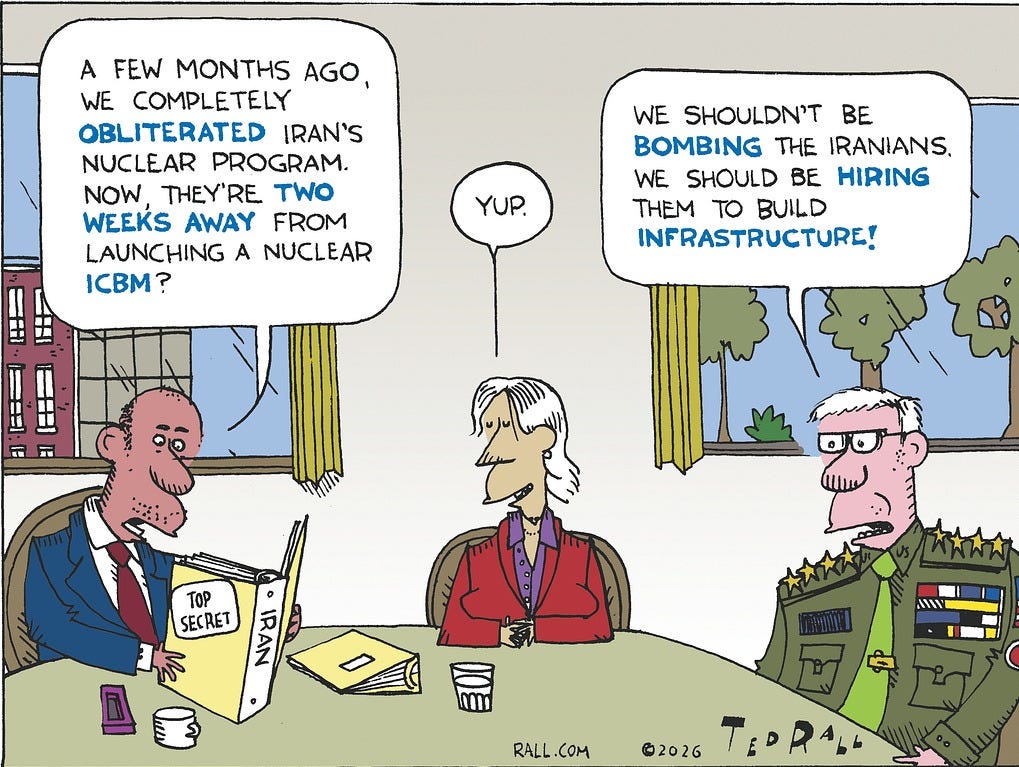
The war has been a spectacular success.
Bibo said so hourly. Stick said so whenever the cameras were rolling. Between them, they had struck, shocked, awed, blinded, deafened, decapitated, demolished and nearly deleted the troublesome theocracy. A minor hitch was that nobody important remained to sign the ceasefire agreement.
“Who’s left?” Stick asked.
“Left?” said Bibo. “Very little.”
“No, politically.”
“Politically, even less.”
Stick frowned. He was the leader of a global superpower and disliked victory speeches that turned philosophical.
“Can they still fight?”
“Yes.”
“Can they still surrender?”
“Not in any legally useful sense.”
That was the problem with decisive victory. It eliminated the very officials required to certify it. You cannot negotiate with the regime until you have destroyed the regime, but once you have destroyed the regime there is no one left to negotiate with. Any regime fit to negotiate with had, by definition, been insufficiently liquidated.
Bibo called this winning. Stick called it complicated.
Marcovelli was summoned to find a way out. He was Stick’s envoy for de-escalation, backchannels, maritime stabilization, hostage deals, postwar sequencing and certain canal-adjacent matters. He had four folders, three phones, and the air of a man being pursued by his own expensive, ill-fitting Florsheims.
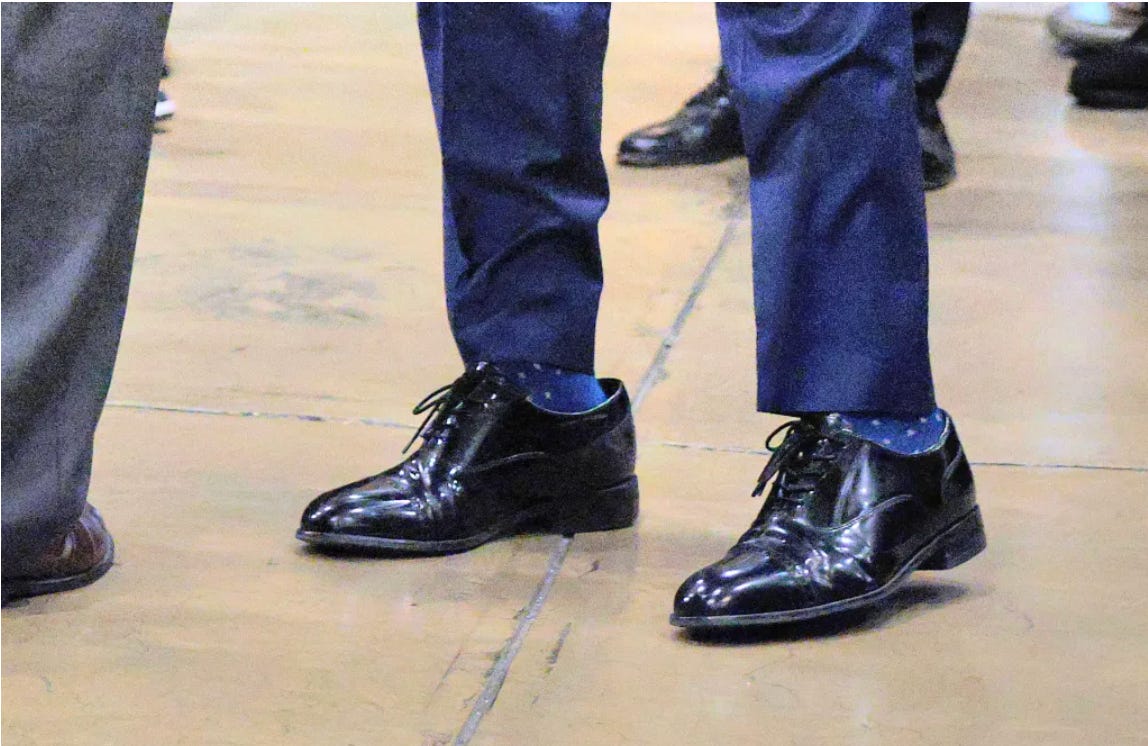
“We are opening talks,” he announced.
“With whom?” asked Stick.
“With the Middle Kingdom, the khakis, several surviving under-clerics, a shipping consortium, and one ophthalmologist in Muscat who appears to know everybody.”
“Can any of them sign?”
“Not directly.”
“Can they sign indirectly?”
“That is our working assumption now.”
The khakis had made contact with the remaining inmates, who seemed to be celebrating. This was interpreted as relief, gratitude, tactical confusion, or the uplifting effect of outliving their senior oppressors. In war, anyone trying to keep you alive could become a suspect, and anyone trying to kill you could become a negotiating partner.
The Middle Kingdom was more constructive and creative. Since no flesh-and-blood ayatollah of sufficient rank remained conscious or available, it proposed installing an artificial one. He/They/It would be called Agent K. It would be built on a cutting edge open-source LLM trained on sermons, sanctions, martyrdom rhetoric, anti-imperialist Farsi poetry, port regulations, doctrinal ambiguity and maritime insurance rules.
“Can Agent K sign a ceasefire?” Stick asked.
“Immediately,” said the Middle Kingdom.
“Can they deny signing it later?”
“Only on premium settings, currently deactivated.”
“Sovereignty is not a software update," Bibo said. The Middle Kingdom replied that sovereignty, like everything else, had entered the platform era. Cheap drones and free open-source models, it observed, had their own elegance. The Americans had deployed very expensive hardware. The way forward, it suggested, was not more bunker-busters but a synthetic cleric for what remained of Iran, with excellent recall and a flair for escalation.
A provisional arrangement emerged. Or at least its outline. Hormuz would be jointly administered by Stick and Agent K pending the reappearance of a sufficiently organic authority. The Red Sea would be supervised by Stick and the Middle Kingdom, since shipping lanes were too important to be left to rebels, believers or Europeans.
Marcovelli, sensing his portfolio ripen by the minute, proposed temporary direct oversight of Venezuela, Cuba and Panama Canal matters, including a post-presidential career track for Stick in user-fee stabilization. Payments will no longer be accepted in dollars or yuan, only in $STRAITFACE.
“Why are we administering half the planet?” Stick asked.
At that point, the Board of Peace was reconvened. Since peace had not blossomed, it was decided to rebrand it as the Board of Pieces. It had originally been formed to transform Gaza. It had a logo, six subcommittees, seventeen flags, and no measurable effect on reality. Now it was assigned Hormuz, the Red Sea, synthetic regimes, trade stabilization, and assorted aftermaths.
“What about Gaza?” asked the Indonesian delegate.
The chairman looked irritated. “Gaza remains central.”
“In what sense?”
“In the continuing sense.”
This satisfied the room. Gaza was placed in suspended animation, which was the humane phrase for leaving a catastrophe exactly where it was while prioritizing the bigger and more urgent challenges.
Meanwhile Bibo kept bombing because stopping would imply enough, and enough was not a word in his vocabulary.
Stick kept posting because posting implied control, and control was the one commodity his office could still invoice. With impeccable timing, he lobbed expletive-laden civilization ending threats after markets closed and rediscovered nuance before the opening bell.
Marcovelli shuttled from capital to capital like a man trying to staple fog to a treaty. The khakis mediated with the inmates. The Middle Kingdom continued fine-tuning Agent K. The Board of Pieces kept meeting with a prayer and a stock ticker.
Sometime ago, a joint statement was issued. It welcomed decisive progress toward de-escalation, maritime normalization, and durable peace, none of which had occurred yet. It reaffirmed the sovereignty of all parties not currently being rearranged. It announced three new mechanisms, two working groups, and a review process.
“Did we win?” Stick asked.
“We won completely,” said Bibo. “So completely that nobody remains qualified to say otherwise.”
That was how they knew it was a victory.
PS: This is a belated tribute to Joseph Heller’s Catch-22, which I read nearly four decades ago. I’ve forgotten most books I read then and many since. But I haven’t forgotten this one. As I watch world events in 2026, Heller’s logic keeps turning up, as bad policy and good satire often do. In times like these, humour is not an escape from reality but one way of facing it.
I enjoyed the writing a lot, thanks for the laughs.
You missed one banger chance though: Rebranding to "Bored of Peace".