
Bad Judgment
no manual available

Good judgment is the result of experience. Experience is the result of bad judgment.
Stay with that sentence for a moment.
If the proposition is true—and I think it is—it carries an uncomfortable corollary. You cannot be taught judgment. You cannot prompt it, download it, inherit it, or acquire it by reading the right blogs or books. You can only earn it the slow way: by being wrong, absorbing the consequences, and reorienting. There is no shortcut. There are, it also turns out, no gods to pray to.
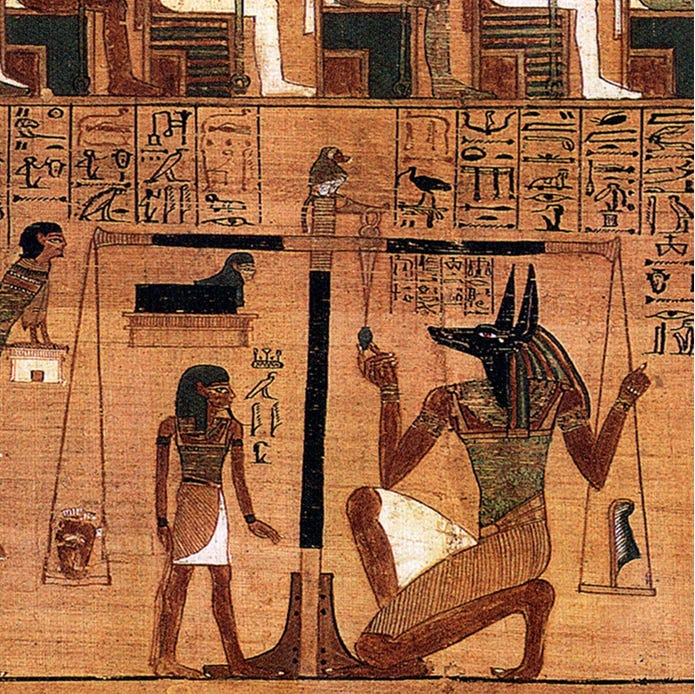
Every storied civilization placed judgment firmly in the afterlife—a reckoning of consequence, of the life already spent. The Egyptians had Anubis, who weighed the heart of the dead against the feather of Ma’at. Greeks, Indians, Chinese—each tradition built their own elaborate machinery of posthumous accounting.
Not one civilization imagined a God who bestowed good judgment upon the living.
This is not a coincidence, to my mind. It’s an admission. The implicit understanding, shared across cultures and millennia, was the same: judgment cannot be foisted upon you from outside. By the time it has fully formed, it is simply part of you. There is nothing left to dispense. And when you are gone, it goes with you.
There are no gods to pray to. There never were.
History confirms what mythology admits—in all walks of life.
Angela Merkel governed Germany for sixteen years as a no-nonsense pragmatic leader. Cautious, methodical, down to earth—her analytical and moral instincts were both widely admired. And yet, in 2015, she carried a dead frame into a live situation. The Syrian refugee crisis called for reorientation: a reading of what Germany and Europe’s social fabric could absorb, what the political consequences would be, what signals were being ignored in favour of what she already believed. Her intelligence was intact, her moral compass was pointing correctly. But her orientation failed her.1
Business offers an equally instructive contrast. Kodak saw the digital future before any other company. In 1975, one of their engineers built the world’s first digital camera. The company looked at what it had, and hesitated—waiting, in effect, for permission from its own past. Nvidia, in a different industry, later faced the same technological disruption from a different angle and went after it. Jensen Huang saw that GPUs built for gaming could be reoriented toward machine learning at scale. Both companies could see significant aspects of what was coming. Kodak held back, weighed down by what had worked before. Nvidia leaned in. The difference was not intelligence, resources, or access to information. It was the willingness to let go of the old frame—and the judgment to see what the new one required.
Judgment, then, is the ability to recognise when your current frame is dying or dead and what the situation now demands. Not a processing problem. A reorientation one.
Ralph Waldo Emerson approached this from a different vantage point. Man is only half himself, he wrote; the other half is his expression—the capacity for moral perception, aesthetic sensibility, the ability to read what a moment requires, accumulated through art, books, music, conversations, and lives lived alongside others. Without that accumulation, we have the instrument but not the ability to create good music.
What Emerson was describing, without quite saying so, is that the inner half must precede the expression. You cannot reverse the sequence.
Emerson’s famous essay Self-Reliance2 urged readers to trust their own minds—a liberating message for those privileged by years of learning, failure, and reflection. Neal Stephenson points out the catch: when Emerson wrote the essay, he was steeped in the best education his era could offer. When an idea came to him, chances were it was a good one. His advice was appropriate for anyone with his experience.
The new hire told to trust their instincts on day one, and the seasoned leader whose instincts have been forged through decades of trial and error, are receiving identical advice. The results will not be identical. Self-reliance assumes the formative phase has already happened. The advice flatters the unformed into believing that formation doesn't matter.
The philosopher Michael Polanyi made the same argument in a different setting. We know more than we can describe—meaning that a great deal of human competence is embodied, non-verbal, and hence resistant to articulation. Think of the bicycle. No manual, however detailed, can teach you how to ride. You fall until you don’t. The knowledge arrives as experience—the experience of failing until you don’t.
In the 1980s, computer scientists tried to encode expertise in rule-based systems. They hit the same wall every time: experts could explain their conclusions but not their judgment—the sense of when the rule applied and when it didn’t. That wall became known as the AI winter. We haven’t climbed over it yet. We have scaled around it. The benchmark tasks are the articulable ones; the hard cases, where judgment is everything, remain exactly where they were. The experienced physician who reads a patient’s face before the test results arrive—the slight hesitation in the answer, the way they are holding themselves—draws on something no diagnostic AI has found a way to factor. That residue lives in thousands of consultations, not in a dataset.
When tacit knowledge fails to be passed on, the loss extends beyond the individual. When a dialect dies with its last speakers, it takes with it not just words but entire ways of perceiving—the humour embedded in particular turns of phrase, the concepts that exist in no other tongue, the way a community understood itself. Unlike a recipe, it cannot even be partially reconstructed. It doesn’t archive itself. A civilisation can preserve knowledge and still fail to transmit judgment, as Chor Pharn points out.
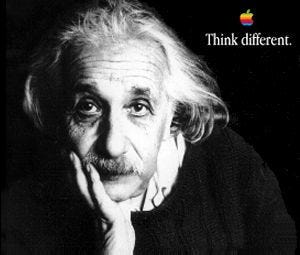
Apple, in 1997, understood none of this, but said it beautifully anyhow. The Think Different campaign gave us Einstein, Gandhi, Picasso—all in high-contrast B&W images, all suggesting that the right posture was the thing: choose to see the world differently, and join the people who change it. It was a visually arresting celebration of independent thinking, but it was silent on what it actually takes to be effective in crunch situations. It showed us the finished person. It left out what it took to get there. What the campaign couldn't show—that would’ve made it a hard sell—was the years of getting it wrong. The experience that was the result of bad judgment, that became in turn the precondition of good judgment.
The other half, missing from every frame. Make Mistakes would have been a bolder, truer slogan.
As the cost of a confident answer falls to almost nothing, some educators are beginning to ask the right question. For decades, institutions designed to develop human capability optimised for the opposite: minimise errors, follow predictable models, chase grades, avoid risk. A reasonable posture for a predictable world. That world is dissolving. And the habits that suited it turn out to be the wrong preparation for what’s coming. What forms judgment is the failed attempt, and the scars. Remove the friction, and you remove the formation.
But this is slow work. And there are no institutional shortcuts.
Develop good judgment is both the most useless advice I can give anyone and the only advice worth giving—because judgment doesn’t have a set curriculum. History books are full of very intelligent people and once successful companies who judged catastrophically. Intelligence isn’t the most important variable. Judgment is. And judgment cannot be bought or dispensed, only accumulated … patiently.
No civilization placed a god of judgment in the land of the living because no civilization believed one was possible. It has to be built from scratch.
Good judgment is the result of experience. Experience is the result of bad judgment.
American military strategist John Boyd developed a framework called OODA—Observe, Orient, Decide, Act—to explain why American F-86 pilots outperformed Soviet MiG-15 pilots in Korea despite the MiG having superior specs. The answer was loop speed: better cockpit visibility and faster controls let American pilots cycle through the loop quicker, getting inside the enemy's decision cycle before they could respond. Boyd later generalised this into a theory of competitive advantage in any fast-moving environment. In our current environment: AI compresses Observe and assists Decide and Act quite effectively in some domains. Orient—identifying what the situation actually demands—remains irreducibly human. That is where judgment lives.
Emerson's Self-Reliance essay (in formal, archaic 1840’s prose) is worth reading for his argument about trusting our own mind, and for the deeper current running beneath it: a synthesis of Eastern and Western thought that influenced Thoreau, Whitman and eventually, through Joseph Campbell, the stories we still tell ourselves. A separate essay on why these ideas keep finding new voices—and whether a revival is overdue—is brewing.
Two readers got back on e-mail with a similar argument: if judgment comes from experience, doesn't long experience sometimes produce worse judgment—the veteran trapped in a frame that once worked?
Yes. And I used the Merkel example to demonstrate this—decades of experience didn't rescue her judgment; in a sense they built the trap. Experience builds judgment and, left unexamined, calcifies it. The scar tissue that should stay sensitive can harden into armour.
The resolution though isn't a new curriculum—the essay's whole point is that judgment never had one. It's that experience is perishable. So the thing worth carrying forward isn't the accumulated answers. It's the willingness to be wrong again, on purpose, when the situation in front of us isn't the one that taught us. Judgment can't be taught. It also can't be retired.
A small improvement from my point of view.
Good Judgement is a result of Experience.
Experience is a result of both, good judgement and bad judgement.
One does incorporate the impact of previous actions that gave good results apart from those that gave poor results.
So, the SUM of ALL the RESULTS of previous actions / decisions forms the Experience that makes You take the present action / decision. And you could still get poor results (make a Bad Judgement) with Many Years of Experience too. One of the factor is the Change / Disruption / Transformation happening in the World. In the changing world, the experience of previous success (or failure) (or good judgement / bad judgement) may not be relevant today.
A very relatable example is that Parenting today is much, much different today from the Parenting that we experienced as adolescents or young adults. Likewise, being a Teacher in a School, even in India, is very much different from what the Teachers were when you and I went to school 50yrs ago.
So, YOU HAVE TO BE A LIFE-LONG LEARNER - LLL or L3 or L^3 in order to be relevant today and tomorrow.